Choosing the right lens for food photography isn’t just a technical decision, it genuinely changes the way people experience your food. The lens becomes your way of inviting the viewer to the table, showing them the crisp edges of a pastry, the shine on a glaze, or the softness of fresh bread. Some shots call for a wide view that captures the whole scene, while others work best when you get close enough to feel the texture.
Whether you’re shooting casual recipes for Instagram or building polished images for a cookbook or commercial project, the right lens helps your food look honest, tempting, and beautifully styled. In this guide, we’ll walk through the lenses that work best in different situations and help you figure out which one matches your style, your space, and the kind of food stories you want to tell.
Best Lenses for Food Photography (Lens Types & Uses)
When you strip food photography down to its tools, almost every food photographer relies on one of four major lens types:
- Wide-angle lenses (16–35mm)
Great for storytelling, interiors, and table scenes. - Standard prime lenses (35–60mm)
The everyday workhorses for flat lays, natural perspectives, and lifestyle scenes. - Short telephoto lenses / macro lenses (85–105mm)
Ideal for professional hero shots, textures, and depth. - Zoom lenses (24–70mm, 24–105mm)
Perfect for fast-paced restaurant or hotel shoots when versatility matters most.
These categories cover virtually all food photography lenses used worldwide, from beginners on their first camera to commercial professionals shooting packaging and ad campaigns.
Wide-angle lenses for food photos (around 16–35mm)
Wide-angle lenses, typically in the 16–35mm range, give food photography a completely different feel.
Instead of focusing on a single plate, they capture the surrounding scene, the story of the table, and the sense of presence in the environment.
16mm creates a dramatic, bold look, while 20mm and 24mm are perfect for restaurant scenes, detailed table spreads, and bright, lively spaces.
28mm is often used in editorial-style work to make scenes feel natural, and 35mm is usually the widest safe option for most food photography setups because it maintains intimacy without exaggerating perspective.
Common choices for food photography
- 16mm; great for very wide, storytelling shots
- 20mm; ideal for environmental food portraits, showing food in its context
- 24mm; popular for restaurants, cafes, and overhead table scenes
- 28mm; used for editorial storytelling and realistic scene captures
- 35mm; the widest “safe” choice for most food setups

When food photographers use wide-angle lenses
Photographers typically reach for wide-angle lenses when they want to capture the entire scene, not just a single dish. These lenses excel at full tables with multiple plates, restaurant interiors with ambient lighting, or chef portraits combined with food. If your goal is to convey presence, movement, or the atmosphere of a real dining experience, a wide-angle lens is the perfect tool.
Wide-angle distortion warning
One important note: getting too close with wide-angle lenses can stretch plates or make them appear oval and exaggerate lines in the scene. Also, the background blur is not as pronounced as with telephoto lenses. For this reason, wide-angle lenses are better suited for storytelling and scene-setting rather than tight, dramatic hero shots.
Standard prime lenses for food photos
Standard prime lenses, typically 35–60mm, are the versatile workhorses of food photography. They balance natural perspective, minimal distortion, and sharpness, making them ideal for everyday shoots. Whether you’re creating overhead flat lays, lifestyle kitchen stories, or general hero shots, these lenses deliver consistent, high-quality results. 35mm is perfect for capturing the environment and storytelling shots, 50mm remains the classic choice for natural proportions and flattering food compositions, and 60mm macro offers a hybrid solution for general scenes with the option for detailed close-ups.
Common focal lengths
- 35mm – great for lifestyle shots, kitchen stories, and overhead flat lays
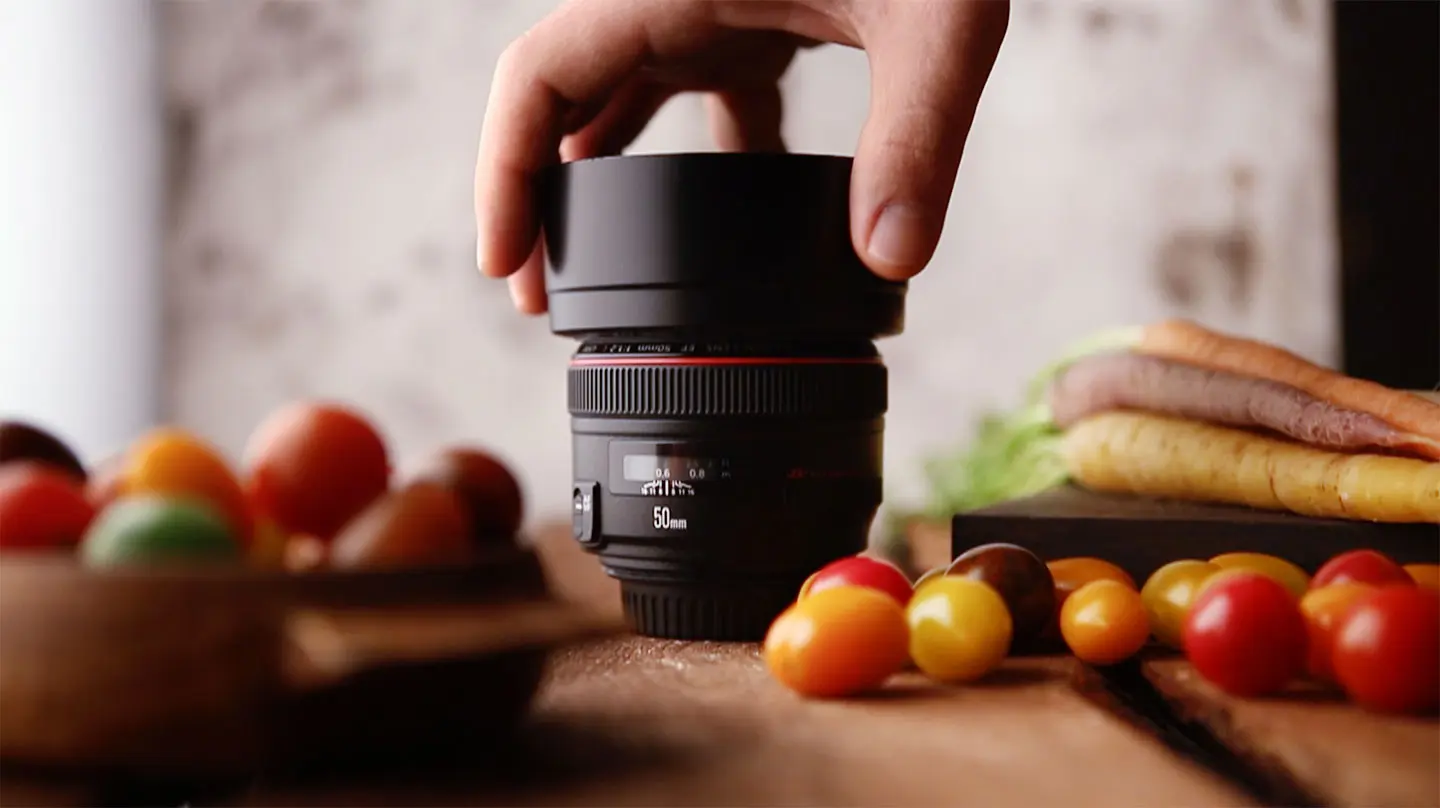
- 50mm – the classic food lens, offering natural, realistic proportions
- 60mm macro – versatile hybrid for general scenes and detailed shots
Why food photographers love this lens group
These lenses are beloved because they provide:
- Natural, realistic proportions
- Minimal distortion
- Excellent sharpness
- Perfect framing for flat lays and 45° angle shots
- Incredible low-light performance (f/1.8, f/1.4)
For those starting out, a 50mm or 35mm prime is often the most popular choice, suitable for both beginners and professional food photographers.

Hero food shots with short telephoto lenses (85–105mm)
Short telephoto lenses, usually ranging from 85mm to 105mm, are the go-to choice for creating striking hero shots in food photography. These lenses let you focus on a single dish or even a particular element, bringing out textures, depth, and richness that make the food appear irresistible. 85mm works well for intimate food portraits, 90mm macro is perfect for capturing tiny details, 100mm macro has become the industry standard, and 105mm macro adds that creamy background with beautifully sharp textures.
Common focal lengths
- 85mm; ideal for food portraits and slightly wider hero shots
- 90mm macro; excellent for capturing fine textures and details
- 100mm macro; the industry standard for professional hero images
- 105mm macro; produces creamy backgrounds with crisp textures
Why short telephotos are the kings of hero images
These lenses excel when you want to make the food stand out as the star of the image. They are perfect for capturing:
- Rich, three-dimensional hero shots
- Tight textures like crumbs, frosting, seeds, or garnish
- Strong background blur and subject separation
- Beautiful compression that elevates the premium feel of the dish
In commercial food photography, the 100mm macro lens is often considered the number one choice for hero shots because it balances clarity, depth, and aesthetic appeal perfectly.

Versatile zoom lenses for food photography
Zoom lenses offer incredible flexibility for food photographers who need to capture a variety of scenes without constantly changing lenses. The most popular options include the 24–70mm f/2.8, which is considered a professional standard, and the 24–105mm f/4, known for its extended reach and image stabilization—perfect for travel or dynamic shoots.
Why zoom lenses shine in food photography
These lenses excel in restaurant, hotel, travel, or documentary-style food photography, where switching between different perspectives quickly is crucial. They let you capture:
- Wide interiors (around 24mm)
- Medium scenes (35–50mm)
- Tight plates and close-ups (70–105mm)
Zooms are ideal for fast-paced environments, allowing you to move seamlessly from broad contextual shots to detailed hero images, all with a single lens.
How to Choose a Food Photography Lens: Key Criteria
The right answer depends on several criteria that shape how your photos look and feel. Below are the most important factors to consider before buying any food photography camera lens.
Sensor size and crop factor in food photography lenses
Your camera’s sensor has a big impact on how a lens behaves. On APS-C / crop sensor cameras, your focal length effectively multiplies by about 1.5×:
- 35mm behaves like ~52mm
- 50mm behaves like ~75mm
On full-frame cameras, the lens shows its true focal length.
Why it matters
- For flat lays, wider lenses (24–35mm) are easier to use on APS-C cameras.
- For hero shots, a crop sensor makes a 50mm lens feel more like a telephoto, something many food photographers enjoy.
- If you plan to upgrade to a full-frame body later, pick lenses that perform well on both sensor types.
How focal length changes the look of food lenses
Your focal length shapes several important aspects of your food photography:
- Plate proportions
- Background size
- Texture emphasis
- Depth and compression
- Viewer’s emotional perspective
Examples:
- 35mm: storytelling, kitchen scenes, full table spreads
- 50mm: classic, natural, neutral perspective
- 100mm: dramatic, luxurious, shallow depth of field
Choosing the right focal length for your shots:
- Flat lays: 35–50mm
- Hero shots: 85–105mm
- Lifestyle restaurant scenes: 24–35mm
- Extreme detail shots: 60–100mm macro
How aperture affects food photography lens choice
A lens with a wider aperture (f/1.4, f/1.8, f/2.8):
- Performs better in low-light restaurants
- Creates stronger background blur (bokeh)
- Makes food appear premium and dimensional
Practical aperture guidelines:
- f/1.8 primes: affordable, perfect for beginners
- f/2.8 zooms: professional, versatile
- f/4 zooms: lighter, cheaper, great for travel
Choosing prime or zoom lenses for food photos
Prime lens benefits
- Sharper
- Better low-light performance
- More consistent look
- Cheaper for high quality
Zoom lens benefits
- Faster workflow
- One-lens convenience
- Perfect for restaurants and events
Summary
- Choose primes if you want the highest quality and the “food photography look.”
- Choose zooms if you shoot fast-paced environments where you can’t change lenses.
Macro lens options for close-up food photography
Is a macro lens good for food photography?
Absolutely: it is essential for detailed work.
Why macro matters:
- True 1:1 magnification
- Short minimum focusing distance
- Perfect for textures like frosting, crumbs, herbs, and grill marks
- Industry standard for cookbooks, packaging, and ads
If your style includes tight, detailed shots, a macro should be one of your first lenses.

Image stabilization in food photography lenses
Image stabilization (IS/VR/OSS) is incredibly helpful for:
- Dim restaurants
- Handheld food videos
- Longer focal lengths (85–105mm)
- Travel food photography
- Avoiding tripod use in fast-paced environments
Stabilization is not mandatory for studio photographers, but it is almost a must-have for restaurant and lifestyle food creators.
When pro lenses matter in food photography work
Professional lenses:
- Have superior contrast, color, clarity, and highlight handling
- Maintain detail in glossy surfaces (oil, glaze, chocolate)
- Offer sharper edges and smoother bokeh
- Use faster autofocus for chef portraits and video
Social-only creators may start with affordable lenses, but commercial photographers typically require:
- Macro lens (90–105mm)
- 24–70mm f/2.8
- High-quality 50mm prime
Choosing a lens brand and system for food photos
When selecting lenses for food photography, it’s important to match your lenses to your camera system and think about future upgrades. Here’s a quick guide for popular brands:
- Canon
Best RF lenses for food photography: 35mm, 50mm, 100mm macro, RF 24–105mm f/4L - Sony
For the Sony A7III, top choices are 50mm, 90mm macro, 24–70mm f/2.8 - Nikon
Excellent options include Z 50mm, Z 105mm macro, Z 24–120mm - Fujifilm
Popular Fuji lenses: XF 35mm, XF 60mm macro, XF 80mm macro
Pro tip: Always ensure your lenses match your camera mount (RF, EF, Z, E-mount, X-mount) and consider lenses that will still be useful if you upgrade your camera in the future.
Project-Based Food Photography Lens Recommendations
Below is a scenario-based table that turns your needs into the right lens type.
| Project Scenario | Recommended Lens Type | Why This Lens Works |
| Flat lays / overhead shots | 35–50mm (24–35mm on crop) | Natural perspective without distortion |
| Single-plate hero shot | 85–105mm macro | Premium look, beautiful depth, texture, clarity |
| Extreme close-ups | 60mm or 100/105mm macro | True magnification, crisp details |
| Food vlogging in cafes | 16–24mm wide prime | Fits face and environment at arm’s length |
| Restaurant interiors | 16–35mm | Captures ambiance, tables, and decor |
| Lifestyle kitchen shots | 35mm | Natural storytelling perspective |
| Chef portraits + food | 50mm or 85mm | Beautiful people-food balance |
| Travel food photography | 24–105mm zoom | One lens for everything on the road |
| Cookbooks/menu photography | 100mm macro | Industry standard for sharp, consistent hero shots |
| Social media content creation | 35mm or 50mm | Affordable, crisp, easy to use |
Best Affordable Food Photography Lens Kits
Not everyone begins with a studio, strobes, or a bag full of expensive glass. Below are the best kits for beginners, intermediates, and professionals.
Best starter lenses for beginner food photographers
The best affordable choices:
- 35mm f/1.8: perfect for small kitchens and flat lays
- 50mm f/1.8: the best-value food lens
- Entry macro (60mm): optional but great for details
Mentioned lens
Sony FE 28–70mm f/3.5–5.6 OSS
A budget-friendly all-in-one lens for beginners.
Not ideal for hero shots or deep macro work, but extremely practical for learning.
Why these lenses work for beginners
- Affordable
- Lightweight
- Easy to use in tight home kitchens
- Perfect for learning composition, light, and styling
Core lens kits for intermediate food photographers
At this level, most photographers upgrade to a 2–3 lens kit:
- 50mm f/1.8 or f/1.4 : main storytelling lens
- 90–105mm macro: professional hero shots
- 24–70mm or 24–105mm: versatility for client work
This kit lets you shoot everything from cookbooks to restaurant interiors.
Essential lenses for professional food photographers
Professionals shooting:
- Packaging
- Advertising
- Commercial menus
- Books
- Social campaigns
Recommended pro kit:
- 100mm / 105mm macro: must-have
- 50mm f/1.2 or f/1.4:signature look
- 24–70mm f/2.8 : workhorse for clients
- 35mm f/1.4 :editorial storytelling
Pros choose lenses based on:
- Color consistency
- Sharpness
- Chromatic aberration control
- Highlight roll-off
- Bokeh quality
Elevate Your Food Photography, Helio Is Here to Help
If you’re ready to elevate your food photography results, whether you’re building a creator brand, shooting for clients, or crafting beautiful recipe content, tools matter. Choosing the right food photography lens is the first step, but learning how to use it is where your images truly level up.
Explore Helio professional creative resources and take your food photography to the next level.
Choosing the best food photography lens isn’t about picking the most expensive option; it’s about matching the lens to your style, your space, and the type of food stories you want to tell. Whether you prefer dramatic hero shots, bright editorial stories, dark and moody textures, or fast-paced restaurant work, there is a perfect lens for you.
From classic primes like 35mm and 50mm to macro lenses like 100mm and versatile zooms like the Canon RF 24–105mm f/4L, the tools you choose directly shape the visual language of your food photography.
With the guidance in this article, you can confidently select lenses that help you create delicious, vibrant, professional-quality images every time.