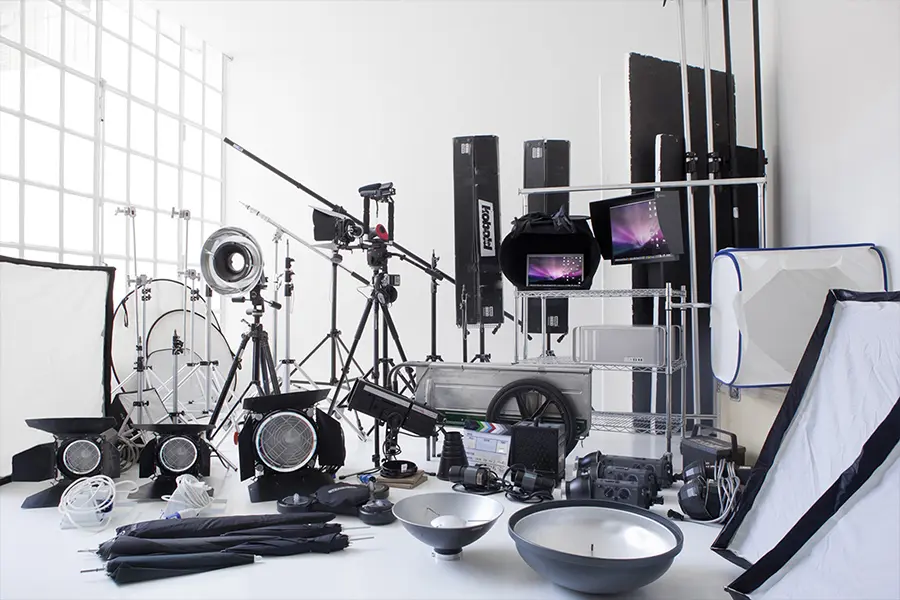
If you search online for a photography studio equipment list, you will usually find something that looks more like a shopping receipt than real guidance. Endless bullets, brand-heavy recommendations, and no explanation of why something matters or when you actually need it. Real studios don’t grow that way.
This guide introduces studio equipment exactly in the order photographers experience it in real life, and it works for all types of studios, from personal setups to professional spaces.
Photography Studio Equipment List (Quick Checklist)
A photography studio is built as a system, not around a single piece of gear. While the camera is the starting point, what truly defines a functional studio is consistency, control, and repeatability.
This quick checklist covers the essential equipment every photography studio needs, whether you’re setting up a home studio, a product photography space, or a professional commercial studio. Use it as a fast reference to make sure nothing critical is missing.
Quick Checklist:
- Camera body (reliable and consistent, not necessarily the newest model)
- Primary studio lens (chosen for perspective and compression, not quantity)
- Studio lighting units (strobes or continuous lights)
- Light modifiers (softboxes, umbrellas, reflectors, grids)
- Background system (stands, rolls, or backdrops)
- Light stands and grip equipment
- Tripod or camera support system
- Power solutions (batteries, cables, extension cords)
- Tethering tools (cables, software, monitor)
- Storage and backup solutions
This checklist focuses on stability and workflow efficiency, helping prevent common studio failures caused by poor lighting control, power issues, or missing files rather than camera limitations.
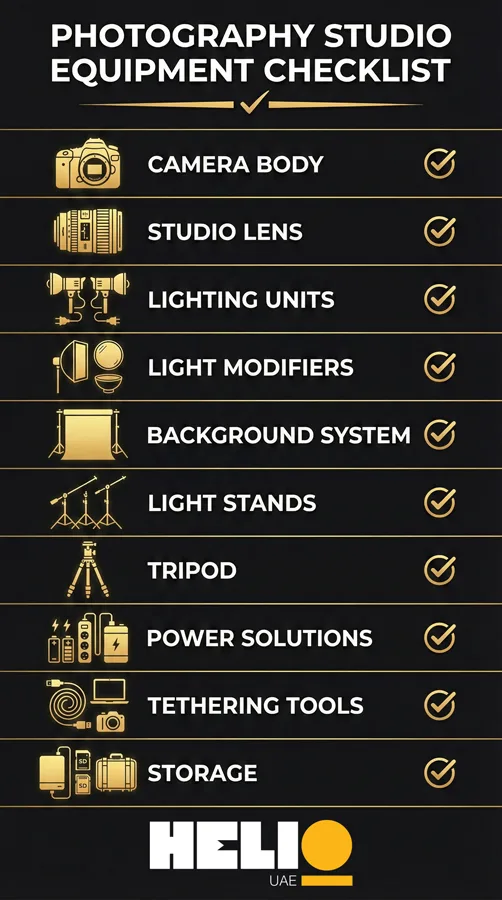
Photo Studio Equipment List by Category (Core Checklist)
When professionals think about a photo studio equipment list, they think in categories, not products. Each category solves a specific type of problem.
-
Studio Space
The studio space is not just a room; it is a controlled environment. Ceiling height affects light placement, wall distance affects lens choice, and ambient light affects consistency. Even a small home studio can function professionally if the space is predictable and controllable.
-
Camera and Capture Tools
In studio photography, the camera is rarely the bottleneck. Reliability, tethering compatibility, and file consistency matter more than megapixel count. This is why many studios standardize on a single camera system across years.
-
Lighting Equipment
Lighting equipment defines whether a studio feels amateur or professional. The key difference is not power, but consistency. Studio lights that recycle at the same output every time allow photographers to work faster and with confidence.
-
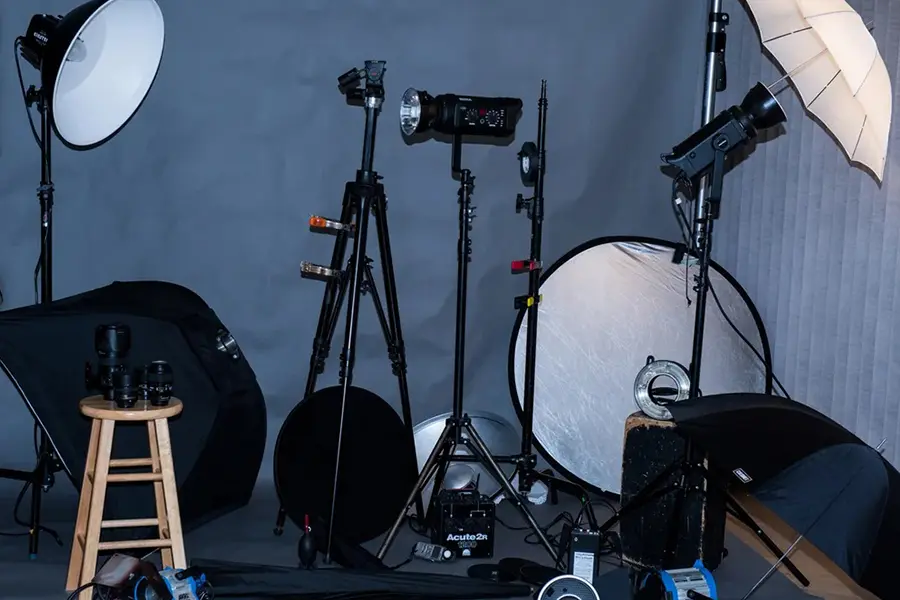
Light Modifiers
Modifiers are where style lives. Softboxes, diffusion panels, and grids allow photographers to sculpt light instead of fighting it. Over time, most studios discover that modifiers matter more than adding new lights.
-
Background Systems
Backgrounds control context. Seamless paper, fabric, or hard surfaces each communicate something different. A flexible background system allows a studio to adapt to portrait, product, or editorial work without re-lighting from scratch.
-
Stands and Grip Equipment
Grip equipment rarely gets attention, but it protects gear, people, and schedules. Stable stands, counterweights, and arms allow precise positioning without constant adjustments.
-
Tripods and Stabilization
Tripods are not only about sharpness. In studio work, they allow repeatability. Product photography, composite work, and client revisions all rely on fixed framing.
-
Tethering and Monitoring
Tethering changes how photographers see. Large previews reveal focus errors, lighting imbalances, and styling issues instantly. For client-facing studios, tethering builds trust and speeds approvals.
-
Storage and File Management
A studio without backups is a liability. Redundant storage systems ensure that work survives hardware failure, human error, and time.
-
Software and Calibration
Editing software and color-calibrated displays ensure that what you deliver matches what you shot. Inconsistent color destroys professional credibility faster than any lighting mistake.
-
Business Essentials
Scheduling tools, contracts, invoicing, and documentation are part of the studio ecosystem. A photography studio equipment list that ignores business tools is incomplete.
Photography Studio Equipment for Beginners
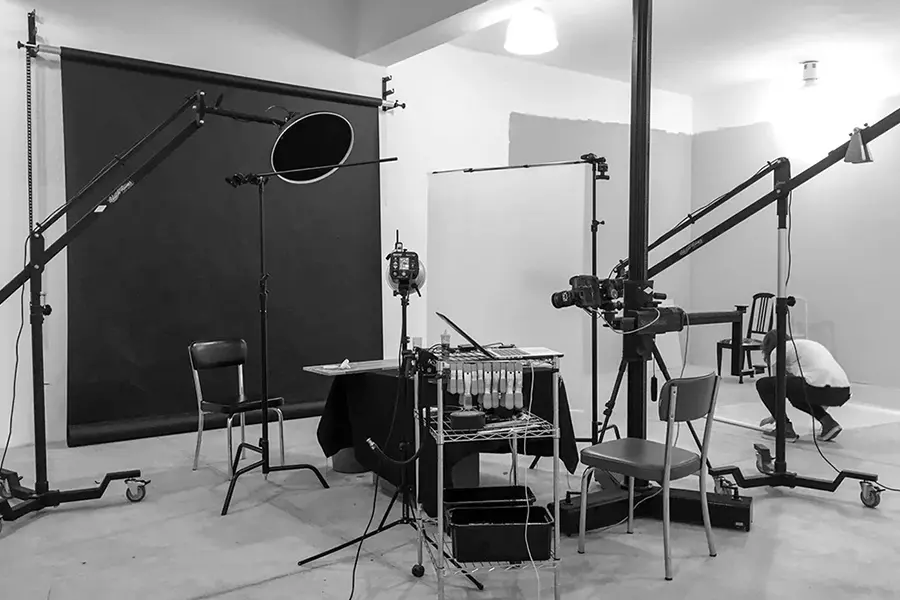
Photography studio equipment for beginners should reduce friction, not add complexity. Beginners need tools that teach fundamentals without overwhelming decisions.
A beginner studio typically starts at home, with limited space and budget. The focus should be on learning how light behaves, how distance changes softness, and how consistency improves results. Simple lighting, one reliable lens, and a manageable backdrop system are enough to build confidence and skill.
Beginners benefit most from equipment that reveals mistakes clearly. Continuous lighting, for example, allows instant visual feedback, which accelerates learning far more than complex setups.
Professional Photography Studio Equipment List
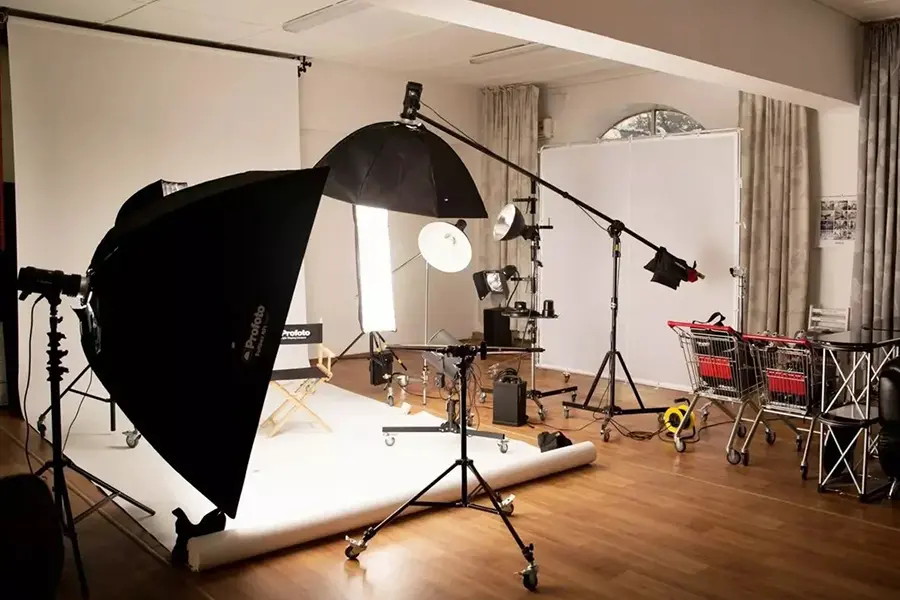
A professional photography studio equipment list prioritizes durability, precision, and repeatability. Professional studios shoot longer sessions, handle clients, and repeat setups across weeks or months.
Redundancy becomes critical at this level. Backup cameras, duplicate lights, and reliable power systems protect revenue. Tethering becomes standard, not optional, and storage systems expand to include on-site and off-site backups.
Professional studios invest less in variety and more in control. The goal is not creative experimentation every day, but predictable excellence.
Beginner Mini Kit (Minimum Viable Home Studio)
- Entry-level mirrorless camera body (APS-C or full-frame)
- Standard zoom lens (24–70mm equivalent)
- Single manual strobe light with softbox
- Lightweight aluminum tripod
- Basic light stand (air-cushioned preferred)
- Collapsible reflector (5-in-1)
- Seamless paper background roll
- Memory cards + external portable hard drive
Pro Upgrade Kit (Durability, Control, Repeatability)
- Dual professional camera bodies (primary + backup)
- Prime lens set (35mm / 50mm / 85mm)
- Multi-head studio flash system with power packs
- Heavy-duty C-stands with grip arms
- Color-calibrated reference card (e.g. ColorChecker)
- Tethering system (dedicated cable + capture software)
- Uninterruptible power supply (UPS) for lights and computer
RAID-based local storage + automated off-site backup
Photography Studio Equipment Names (Quick Glossary)
Photography studio equipment names often sound technical, but each term exists because it solves a real problem. A C-stand provides unmatched stability for heavy modifiers. A boom arm allows overhead light placement without entering the frame. Sandbags prevent accidents. Grids control light spread.
Gobos shape light. Seamless paper creates distraction-free backgrounds. Tethering connects camera to screen. Color checkers ensure accurate tones. Diffusion panels soften light. Flags block spill. Grip heads lock accessories. Clamps create instant mounting points.
Knowing these terms helps photographers communicate clearly and work efficiently on set.
- C-Stand: Heavy-duty stand for supporting lights, flags, and modifiers
- Grip Head: Adjustable clamp that locks arms and accessories securely
- Boom Arm: Horizontal extension for overhead or off-axis lighting placement
- Sandbag: Weighted bag to stabilize stands and prevent tipping
- Grid: Honeycomb modifier that narrows and controls light spread
- Gobo: Cutout or pattern used to shape or block light
- Seamless Paper: Roll background creating clean, distraction-free backdrops
- Tethering: Direct camera-to-computer connection for live image preview
- Color Checker: Reference chart for accurate color calibration
- Diffusion Panel: Translucent surface that softens harsh light
- Flag: Opaque panel used to block or subtract light
- Clamp: Fast-mount tool for attaching gear to stands or surfaces
Equipment Needed for Photo Studio PDF + Pictures Checklist
Many photographers prefer a downloadable reference instead of relying on memory. A printable list of equipment needed for photography studio PDF allows you to plan purchases, track upgrades, and share requirements with collaborators.
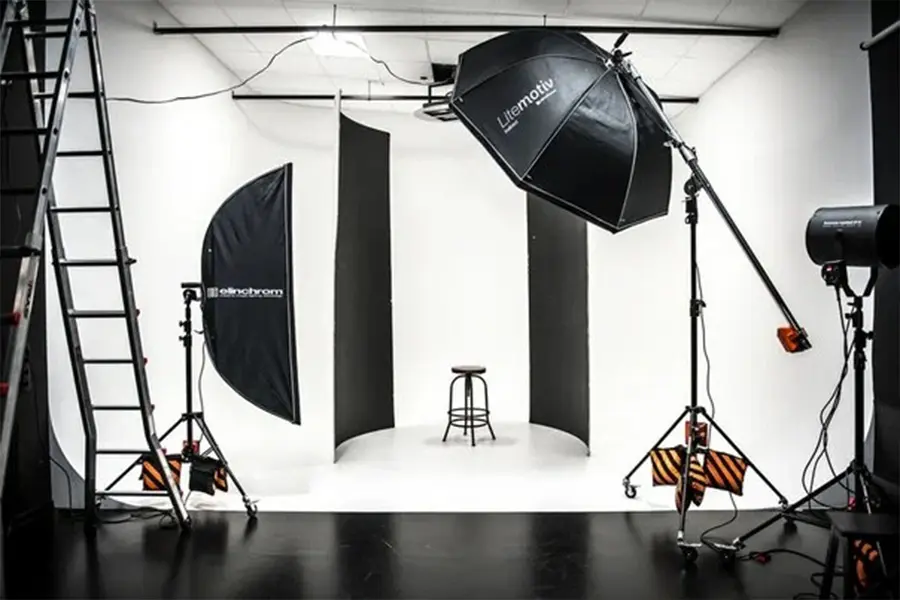
A photo studio equipment list with pictures is most useful when visuals explain categories, not products. Seeing how lighting, grip, and background systems relate spatially helps photographers design better studios.
Photo Studio Accessories List That Prevent Common Problems
Accessories rarely feel important until something goes wrong. Clamps solve last-minute mounting issues. Gaffer tape secures cables without residue. Velcro ties prevent tangled power lines. Extension cords expand placement options. Spare batteries prevent downtime. Microfiber cloths protect lenses. Floor tape marks positions. Surge protectors save electronics. Tool kits enable quick fixes. Photography studio equipment CAD block files help plan layouts before moving anything physically. These items don’t add creativity, but they remove stress.
Turning Studio Equipment Decisions into Clear Systems
Helio is a professional support platform designed for photographers and creative teams who want to build studios that actually work in the real world, not just look good on paper. Instead of pushing products or generic gear lists, Helio focuses on needs-based studio planning, helping you understand what equipment fits your shooting style, space limitations, budget, and growth goals.
Whether you are setting up a small self photo studio, scaling a product photography space, or optimizing a professional commercial studio, Helio approaches the process holistically: from equipment selection and spatial layout to workflow efficiency and future-proof upgrades.
Build Less. Shoot More!
At the end of the day, a photography studio is not defined by how much equipment you own, but by how smoothly everything works together. The smartest studios are built with intention, starting small, adding control where it matters, and upgrading only when the workflow demands it.
If your space allows you to focus on light, timing, and storytelling without friction, then your studio is doing its job. Everything else is just noise.