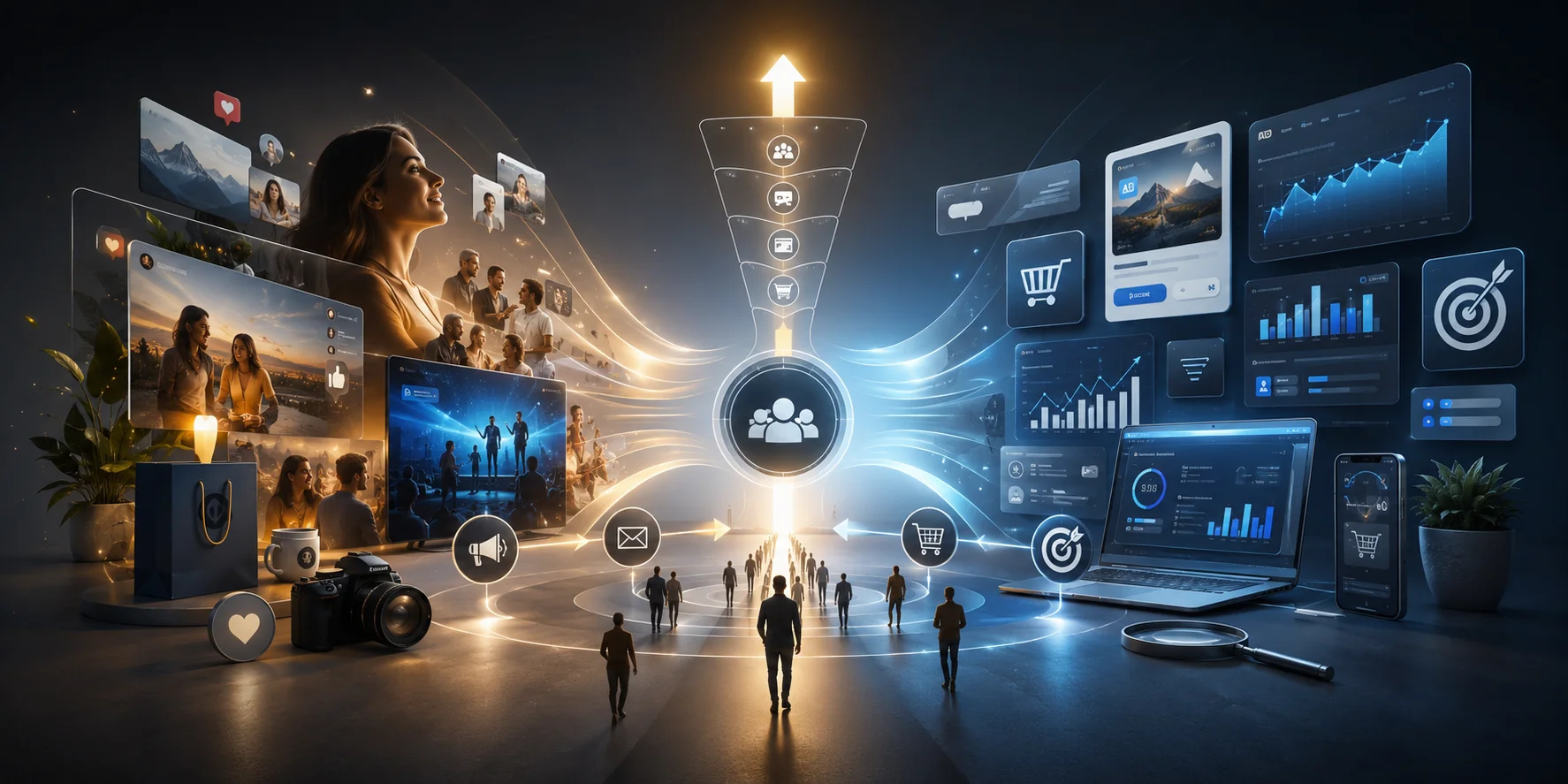
Brand marketing focuses on building recognition, trust, and long-term perception around a business. Its goal is to shape how people remember and emotionally connect with a brand over time.
Performance marketing, on the other hand, is centered around measurable actions such as clicks, leads, purchases, or sign-ups. It prioritizes direct results and campaign efficiency across digital channels.
The strongest marketing systems combine both instead of treating them as competing approaches.
Understanding the difference between brand marketing vs performance marketing helps businesses build more balanced growth strategies.
Brand vs Performance Marketing: Key Differences
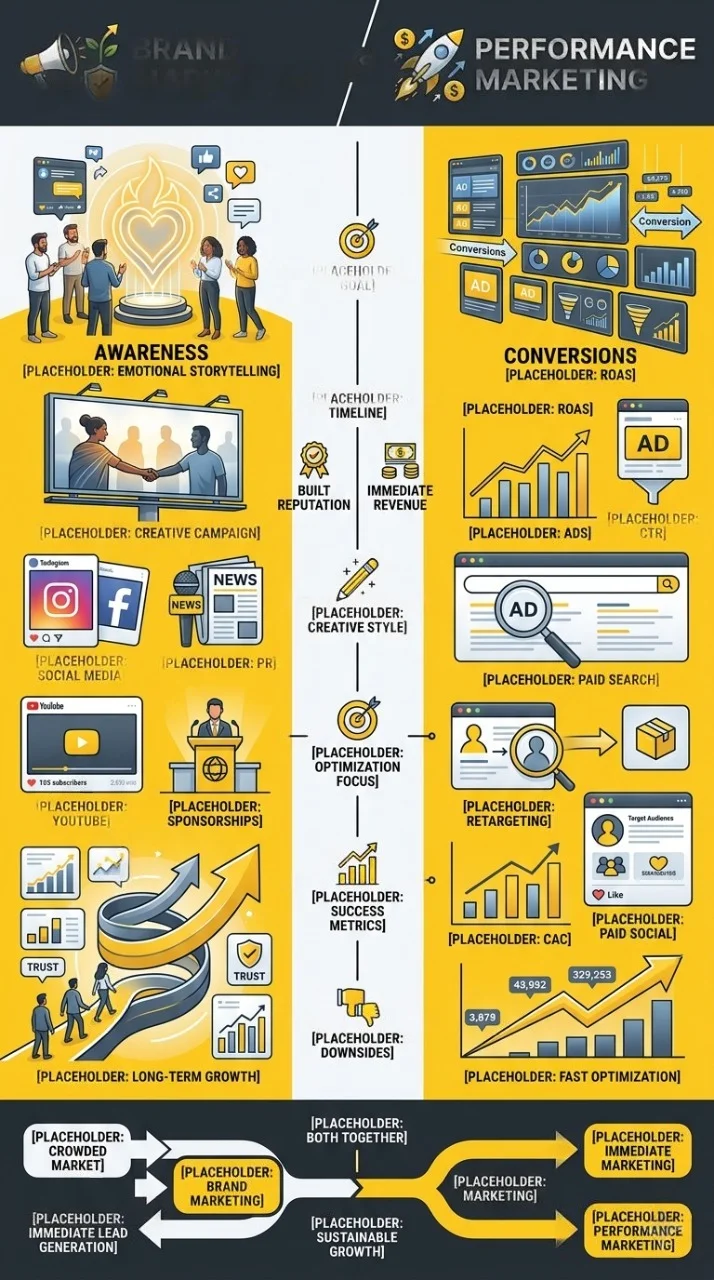
Although both approaches support business growth, they operate with very different priorities, timelines, and measurement models.
| Area | Brand Marketing | Performance Marketing |
| Goal | Build awareness and trust | Drive measurable actions |
| Timeline | Long-term | Short-term to mid-term |
| Optimization Focus | Perception and recall | Conversion efficiency |
| Success Metrics | Brand awareness, search lift, recall | ROAS, CAC, CTR, conversions |
| Channels | TV, social, YouTube, PR, sponsorships | Paid search, paid social, retargeting |
| Creative Approach | Emotional and narrative-driven | Action-focused and conversion-oriented |
| Downside of Over-Relying | Harder to measure quickly | Weak long-term brand memory |
When Brand Marketing vs Performance Marketing Works Best
The effectiveness of each approach often depends on business goals, market maturity, customer behavior, and buying cycles.
When Brand Marketing Should Lead
Brand marketing tends to become more important in crowded or highly competitive markets where businesses need stronger differentiation. It also plays a major role for companies with premium positioning, longer buying cycles, or industries where customer trust takes time to build.
In categories like healthcare, finance, real estate, or high-ticket services, people rarely make decisions after a single ad interaction. Brand familiarity and credibility often influence the final decision long before conversion happens.
When Performance Marketing Should Lead
Performance marketing usually becomes more valuable when businesses need immediate lead generation, faster customer acquisition, or quick validation for a product or offer.
It also works well in shorter sales cycles where users are already close to making a decision and campaigns can be optimized around measurable actions such as purchases, sign-ups, or inquiries.
Why Most Businesses Need Both
Brand marketing helps create future demand by increasing familiarity and trust over time. Performance marketing then converts that attention into measurable business outcomes.
Relying only on brand marketing can slow down acquisition, while relying only on performance marketing often creates short-term growth without long-term brand strength. The healthiest systems balance both.
How Brand Building and Performance Marketing Work Together
The strongest marketing strategies are usually built around integration rather than separation. Instead of operating independently, brand and performance marketing become more effective when they support the same customer journey.
Step 1: Start With One Narrative and One Promise
Strong marketing systems begin with a consistent narrative that explains what the brand stands for and why it matters. That narrative should connect to a clear customer promise supported by proof points such as testimonials, product experience, or measurable outcomes.
When messaging changes too frequently between campaigns, audiences struggle to build familiarity or trust.
Step 2: Build a Creative System, Not One-Off Ads
Many businesses focus on producing individual ads instead of building recognizable creative systems. Consistency across visuals, messaging, tone, and repeated brand cues helps strengthen memory over time.
Repeated exposure to familiar creative elements often improves both brand recall and performance efficiency.
Step 3: Use Full-Funnel Sequencing
Most customer journeys move through different levels of awareness before conversion happens.
- Cold audience: discovering the brand for the first time
- Warm audience: already engaged or familiar with the business
- Hot audience: closer to taking action or converting
Different messaging works better at different stages of this funnel.
Step 4: Use Retargeting as the Connection Layer
Retargeting helps reconnect with users who already interacted with a brand, visited a website, watched content, or engaged with ads.
The strongest retargeting systems match the message to the audience’s previous behavior instead of repeating the same generic offer repeatedly. At the same time, businesses that rely only on retargeting often struggle because they stop generating new audience demand at the top of the funnel.
Step 5: Measure Bridge KPIs Instead of Isolated Metrics
Some metrics help connect brand impact with performance outcomes more effectively than isolated campaign numbers alone.
Important bridge KPIs include:
- Branded search growth
- Direct traffic
- CTR trends
- CVR improvements
- CAC efficiency over time
If brand is working, these improve before last-click ROI fully catches up.
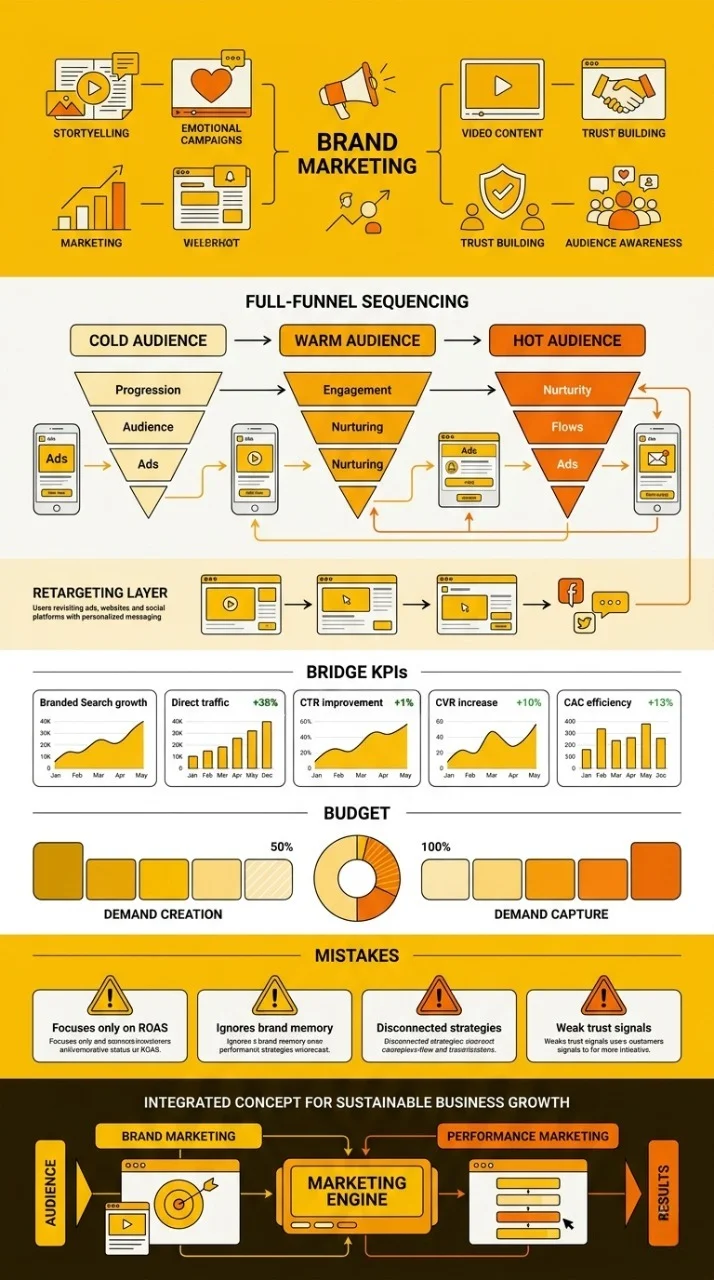
Brand vs Performance Marketing Budget Allocation
There is no universal formula for dividing budget between brand and performance marketing. The right balance usually depends on business goals, market conditions, growth stage, and acquisition priorities.
Instead of treating them as separate investments, businesses often benefit from supporting both demand creation and demand capture at the same time. Budget allocation should also evolve based on performance signals such as branded search growth, conversion efficiency, and customer acquisition trends.
Common Brand and Performance Marketing Mistakes
Even strong campaigns can become ineffective when businesses approach brand and performance marketing as completely separate systems.
Common mistakes include:
- Treating brand and performance as disconnected strategies
- Chasing short-term ROAS only
- Ignoring long-term brand memory
- Refreshing creatives too frequently
- Relying only on last-click attribution
- Scaling ads without strengthening trust
- Focusing on reach without conversion intent
Sustainable Growth Happens When Both Strategies Work Together
Businesses usually grow more sustainably when brand marketing and performance marketing support each other instead of competing for budget and attention. One creates familiarity, trust, and future demand, while the other converts existing demand into measurable results.
The most effective marketing systems are rarely built around a single tactic. They combine long-term brand building with performance-focused execution to create stronger visibility, more efficient acquisition, and better long-term growth.
This is why many businesses work with experienced teams such as Helio Marketing Agency to build marketing strategies that balance both brand strength and measurable performance across the full funnel.