
Paid advertising can create a frustrating situation for businesses: the campaign is generating clicks, traffic is coming to the website, but very few people are actually becoming leads.
At first, the problem may appear to be the advertising campaign itself. However, clicks only tell you that people were interested enough to visit. They do not tell you whether the right people clicked, whether the landing page convinced them, or whether the conversion process was easy enough.
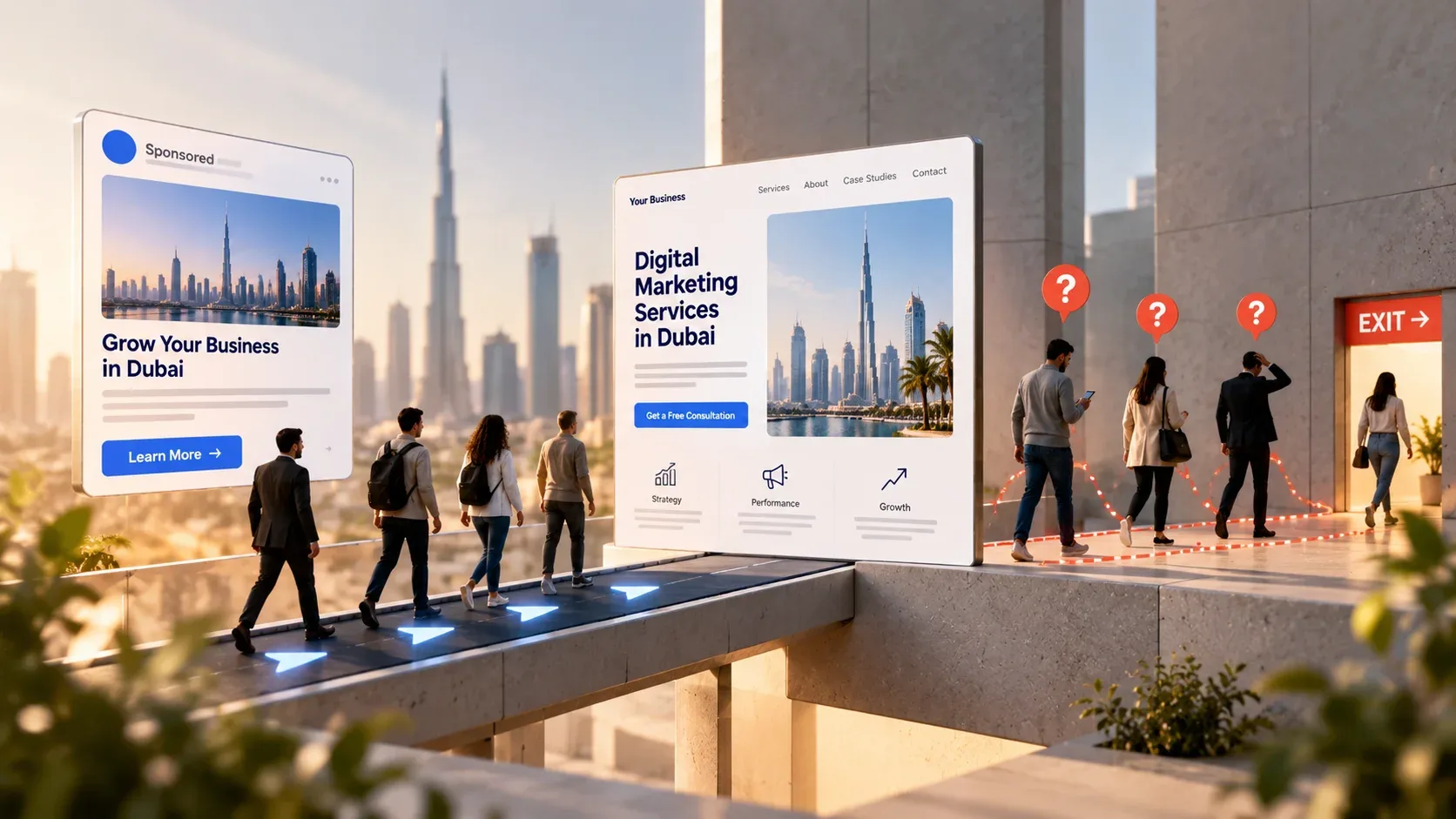
If your paid ads generate clicks but no leads, the problem can exist at several points across the customer journey.
Clicks Are Not the Same as Conversions
A click is only the beginning of the conversion journey.
Someone can click an advertisement because the headline is interesting, the offer looks attractive or the message matches their search. But after arriving on the website, they may discover that the offer is not relevant to them.
This means a campaign can have a healthy click-through rate while producing poor business results.
The important question is not simply:
How many people clicked?
It is:
How many relevant people clicked, took the desired action and became potential customers?
Your Target Audience May Be Too Broad
One of the most common reasons for low lead generation is targeting an audience that is too broad.
For example, a business selling premium B2B services in Dubai may attract thousands of visitors through a broad advertising campaign. However, many of those visitors may not have the budget, authority or business need to become customers.
A better approach is to define the audience around factors such as:
Location
Industry
Business size
Job role
Search intent
Purchase stage
Service requirements
Budget or commercial potential
The goal is not always to generate more traffic.
It is to generate more relevant traffic.
Your Ad Message May Promise Something the Landing Page Does Not Deliver
There should be a clear connection between the advertisement and the page users reach after clicking.
Imagine an advertisement that says:
“Get a Free SEO Audit for Your Dubai Business.”
If the landing page simply opens a generic agency homepage with ten different services, the user has to figure out what to do next.
This creates friction.
The landing page should continue the same message, offer and expectation created by the advertisement.
Your Landing Page May Be Too Complicated
A landing page does not need to contain every piece of information about your company.
Its primary job is to help the visitor understand:
What is being offered?
Why does it matter?
Why should they trust you?
What should they do next?
If users have to scroll through multiple sections before finding the form or CTA, conversion rates can suffer.
Keep the main action obvious.
Your Call to Action May Be Weak
“Submit” is functional, but it does not communicate much value.
A stronger CTA can tell the visitor what happens next.
Examples include:
Request a Consultation
Get Your Free Audit
Book a Strategy Call
Request a Quote
Talk to a Specialist
Get a Custom Proposal
The best CTA depends on the offer and the user's stage in the buying journey.
Your Lead Form May Be Asking for Too Much
Long forms can discourage people from converting.
A business may want to collect:
Full name
Email
Phone number
Company
Job title
Company size
Budget
Industry
Service requirement
Additional comments
But the visitor may not be ready to provide all of this information.
Start by identifying which information is genuinely necessary at the first conversion point.
Additional qualification questions can be introduced later in the sales process.
Your Offer May Not Be Strong Enough
Sometimes the problem is not targeting or design.
The offer itself may not give people enough reason to take action.
For example, “Contact Us to Learn More” requires a visitor to make a commitment without knowing exactly what they will receive.
A more specific offer can reduce uncertainty.
Depending on the business, this could be:
Free consultation
Strategy session
Website audit
Marketing assessment
Product demonstration
Custom quotation
Downloadable industry report
The offer should match both the business model and the user's buying stage.
Your Traffic May Have Low Purchase Intent
Not every keyword or audience produces the same commercial value.
Someone searching for:
“What is SEO?”
has a very different intent from someone searching for:
“SEO agency Dubai pricing.”
Both users may be interested in SEO, but they are at different stages of the decision-making process.
Paid campaigns should distinguish between awareness, consideration and high-intent searches where possible.
Your Website May Be Slow on Mobile
A large percentage of advertising traffic can come from mobile devices.
If the landing page loads slowly, looks difficult to navigate or has a poorly designed mobile form, users may leave before converting.
Check:
Mobile loading speed
Page layout
Form usability
Button visibility
Font size
Navigation
Image optimization
Technical errors
The advertising campaign cannot compensate for a poor landing-page experience.
You May Not Be Tracking Conversions Correctly
Another possibility is that leads are actually being generated but your tracking system is not recording them correctly.
Before changing a campaign, verify that important conversion events are working.
These might include:
Form submissions
Phone calls
WhatsApp conversations
Consultation bookings
Quote requests
Demo requests
Purchases
Check the entire journey from advertisement click to completed conversion.
Your Sales Process May Be the Real Problem
Advertising performance does not end when someone submits a form.
A campaign can generate qualified leads while the sales process fails to convert them into customers.
Consider:
How quickly leads receive a response
Who follows up
How many follow-ups happen
Whether leads are properly qualified
Whether sales teams have enough information
Whether the offer matches what was advertised
Marketing and sales need to work together.
How to Diagnose a Paid Ads Problem
Instead of immediately changing everything, look at the funnel step by step.
Step 1: Check Impressions and Reach
Are you reaching enough people?
If not, the problem may involve budget, targeting, keywords or campaign settings.
Step 2: Check Click-Through Rate
If people see the advertisement but rarely click, the issue may be the creative, headline, targeting or offer.
Step 3: Check Landing Page Engagement
If users click but leave quickly, examine the relevance and quality of the landing page.
Step 4: Check Conversion Rate
If users stay on the page but do not submit a form or take another action, examine the offer, CTA, trust signals and form.
Step 5: Check Lead Quality
Even when conversions increase, make sure they are commercially useful.
A campaign generating 100 irrelevant leads is not necessarily better than one generating 20 qualified leads.
A Better Paid Advertising Funnel
A strong paid campaign should connect four elements:
Targeting → Ad Message → Landing Page → Conversion
Each step should support the next.
The audience determines who sees the ad.
The ad explains why they should click.
The landing page confirms that they have come to the right place.
The conversion mechanism gives them a clear next step.
If one part of the chain is disconnected, the entire campaign can underperform.
Paid Ads Optimization Checklist
Before increasing your advertising budget, review:
Is the audience clearly defined?
Are keywords aligned with search intent?
Does the ad accurately describe the offer?
Does the landing page match the advertisement?
Is the main CTA immediately visible?
Is the offer compelling?
Is the lead form easy to complete?
Does the page work well on mobile?
Are trust signals visible?
Are conversions being tracked correctly?
Are leads being followed up quickly?
Are you measuring lead quality, not only lead volume?
Frequently Asked Questions
Why are my Google Ads getting clicks but no leads?
The issue could be targeting, search intent, landing-page relevance, weak CTAs, a complicated form, poor tracking or an offer that does not provide enough value.
Should I reduce my ad budget if I am getting no leads?
Not necessarily. First identify where the conversion funnel is breaking. Increasing or reducing budget before understanding the problem can make optimization more difficult.
Is a high click-through rate a good sign?
A high CTR can indicate that your advertisement attracts attention, but it does not guarantee conversions or qualified leads. CTR should be evaluated alongside conversion rate and lead quality.
How can I improve the quality of leads from paid advertising?
Use more precise targeting, focus on high-intent audiences, make your offer specific and align your landing page with the audience's needs.
Turn Paid Traffic Into Business Results
Paid advertising should not be judged only by the number of clicks it generates.
The real value comes from turning relevant traffic into meaningful actions and, ultimately, qualified business opportunities.
If your campaigns are generating clicks but not leads, the solution may require more than changing the advertisement. The entire journey from targeting to landing page, offer, conversion tracking and sales follow-up should be reviewed.
HELIO helps businesses build and optimize paid advertising campaigns with a focus on measurable business outcomes rather than traffic alone.