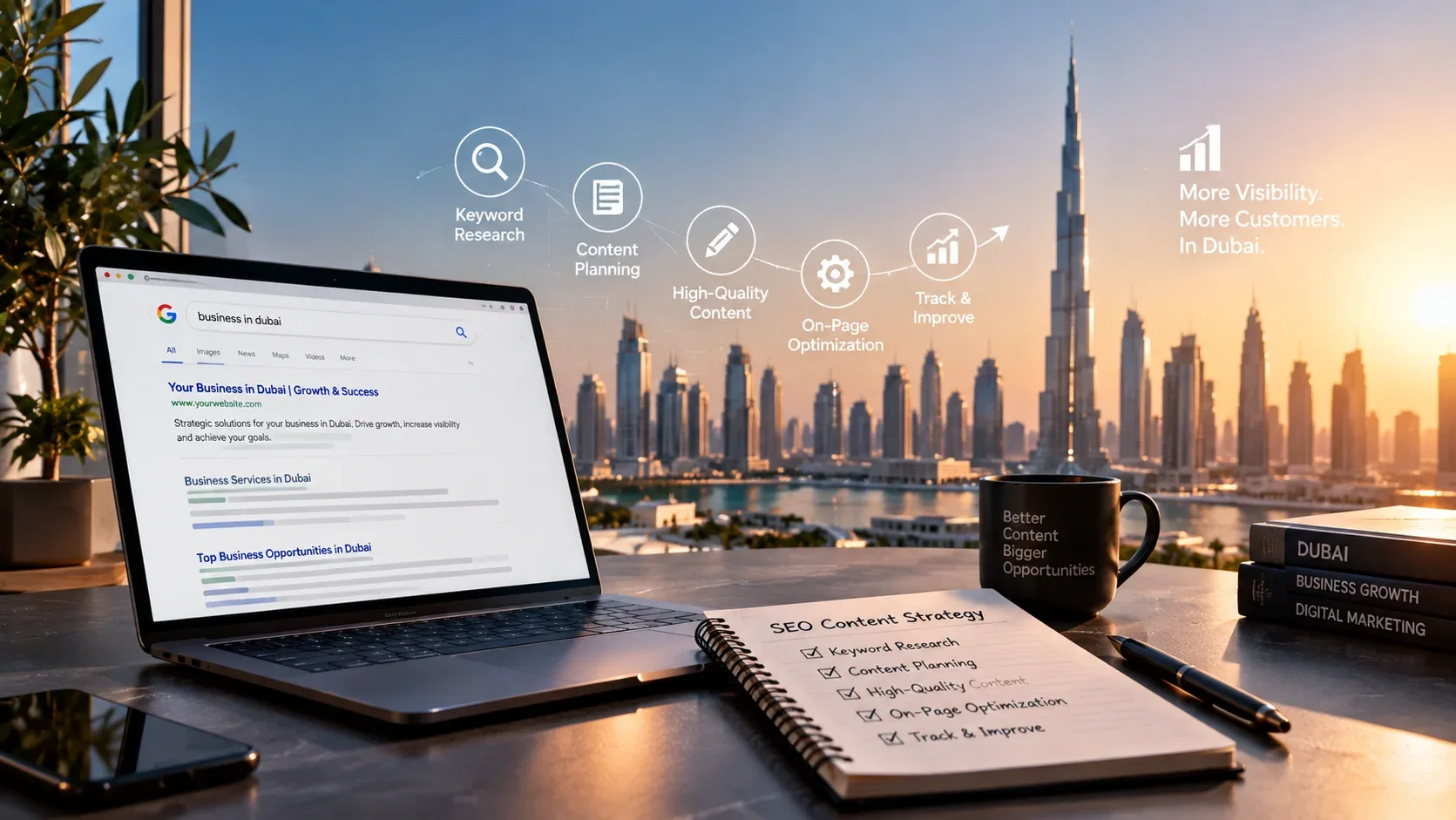
Publishing blog articles consistently does not automatically create SEO growth.
A business can publish dozens of articles and still struggle to generate qualified organic traffic if the content is disconnected from its services, customer journey and search intent.
A strong SEO content strategy starts with the business, not the blog.
Start With Business Goals
Before choosing keywords, define what organic search should contribute.
Possible objectives include:
Lead generation
E-commerce sales
Brand discovery
Local visibility
Product discovery
Qualified traffic
Supporting sales conversations
A content strategy should then connect these goals to search behavior.
Identify Commercial Topics
Not every keyword deserves an article.
A business should prioritize topics that have a meaningful relationship with its services or products.
For example, a marketing agency might create content around:
Local SEO
E-commerce SEO
Lead generation
AI search
Each topic can connect naturally to a commercial service.
Map Search Intent
A useful framework is:
Informational → Commercial → Transactional
An informational query might ask:
What is technical SEO?
A commercial query might ask:
Technical SEO services UAE
A transactional query could be:
SEO agency Dubai
The website needs different content for each stage.
Build Topic Clusters
Instead of publishing isolated articles, organize content into clusters.
For example:
SEO
→ Technical SEO
→ Local SEO
→ E-commerce SEO
→ Arabic SEO
→ AI Search
→ Content Strategy
A pillar or service page can then connect these topics.
This creates a clearer architecture for both users and search engines.

Create Content Around Real Questions
Good SEO content should answer questions customers actually have.
These questions can come from:
Search queries
Sales conversations
Customer support
Competitor research
Search Console
Industry discussions
The best topics often sit at the intersection of search demand and customer problems.
Don't Ignore Existing Content
A mature website should not treat every content opportunity as a new article.
First check:
Existing URLs
Existing rankings
Search queries
Duplicate topics
Content decay
Cannibalization
Sometimes updating an existing article is more valuable than publishing another similar page.
Build Internal Links Intentionally
Every article should have a reason to exist within the website.
It should link to:
Relevant service pages
Related articles
Industry pages
Case studies
Commercial landing pages
Likewise, commercial pages should link back to useful supporting content.
Create Content for Different Stages
A balanced strategy can include:
Awareness Content
Broad questions and educational topics.
Consideration Content
Comparisons, frameworks, guides and implementation advice.
Decision Content
Pricing considerations, service guides, checklists and provider-selection topics.
The balance depends on the business model.
Localize for Dubai
Dubai is not simply a keyword added to the end of a title.
Local content should provide genuine relevance through:
Local market context
Customer behavior
Regulations where relevant
Industry conditions
Geographic considerations
UAE-specific examples
This creates stronger local value than keyword repetition.
Measure Business Impact
Track more than traffic.
Useful metrics include:
Organic clicks
Impressions
CTR
Rankings
Qualified sessions
Leads
Assisted conversions
Revenue where applicable
The goal is to understand which content contributes to business growth.
Final Thoughts
An SEO content strategy works best when content is treated as part of a larger system.
For a Dubai business, that system can connect local search, service pages, topic clusters, internal linking, commercial intent and conversion paths.
The objective is not to publish more.
It is to publish with a reason.
Frequently Asked Questions
How many SEO articles should a Dubai business publish each month?
There is no universal number. Quality, topical relevance and the ability to support and maintain the content matter more than volume.
Should every keyword have its own article?
No. Closely related keywords can often be addressed by one comprehensive page.
Is local SEO separate from content SEO?
They overlap. Local relevance can be incorporated into broader content and technical SEO strategies.